Department of Human Nutrition
Department of Human Nutrition
1. Department Overview
1.1 Introduction
Nutritional science is now a field of growing importance in many aspects of healthcare, lifestyle, industry and policy development. Improved nutritional status is also key to achieving the Sustainable Development Goals (SDGs), as it directly contributes to productivity, poverty reduction and economic development by improving physical and psychological health — thus laying the foundation of stable, secure and peaceful societies.
The primary goal of establishing the Department of Human Nutrition at KMU is to improve the nutritional status of the people of Pakistan in general, and Khyber Pakhtunkhwa in particular, through cutting-edge research, education and outreach programs. The department focuses on research targeted at understanding local nutritional problems and developing cost-effective nutritional strategies, and aims to be the national leader in producing highly skilled nutrition graduates from diverse backgrounds to overcome the scarcity of skilled human resources in this field.
The Human Nutrition Program endeavors to be a world-class academic and research program, providing quality education and advanced knowledge in Human Nutrition to those who seek excellence in the field.
1.2 Vision
To be a national center of excellence in Human Nutrition research and education.
1.3 Mission
The Human Nutrition Program endeavors to be a world-class academic and research program providing quality education and advanced knowledge in Human Nutrition to those who seek excellence in the field. The program aims to strengthen and continuously improve its postgraduate offerings through curriculum enhancement, research innovation, and academic diversification, while facilitating the development of competent nutrition scientists, researchers, and professionals capable of addressing national and global nutrition and public health challenges.
MPhil Human Nutrition
Our MPhil Human Nutrition program is the most appropriate qualification for future nutrition professionals. The Department of Human Nutrition at KMU aims to provide an MPhil program that is both educationally sound and directly relevant to the country's future needs in nutritional sciences. The overall aim is to produce quality nutrition professionals with vision, knowledge, creativity and leadership skills to improve the quality of nutritional care in the region and country as a whole.
PhD Human Nutrition
The PhD Human Nutrition program aims to produce scholars of high intellectual caliber who will be able to conduct scientifically rigorous research in the field of Human Nutrition. Through continuous professional development and advanced research, graduates of this program will contribute to innovation and evidence-based practices in the healthcare system of the country and to the well-being of society at large.
1.4 Objectives
Program Objectives:
- Develop advanced knowledge and critical understanding of human nutrition, nutritional sciences, and public health nutrition to address complex nutrition-related challenges at individual, community, and population levels.
- Equip graduates with advanced research competencies to design, conduct, analyze, and disseminate high-quality scientific research that contributes to evidence-based nutrition practice and policy development.
- Enhance professional and technical skills required for nutritional assessment, dietary planning, data analysis, and the application of contemporary technologies and research tools in nutrition and health sciences.
- Prepare graduates for leadership and interdisciplinary collaboration in academic, clinical, community, governmental, and research settings to improve nutrition and health outcomes.
- Promote ethical and professional conduct by fostering integrity, accountability, cultural sensitivity, and adherence to ethical principles in research, education, and nutrition practice.
- Develop effective communication and lifelong learning skills that enable graduates to disseminate scientific knowledge, engage diverse stakeholders, and continuously update their professional competencies.
- Cultivate commitment to community engagement and public service by enabling graduates to contribute to nutrition advocacy, disease prevention, health promotion, and sustainable solutions to national and global nutrition challenges.
2. Academic Information
2.1 Programs Offered
Programs
- PhD Human Nutrition
- MPhil Human Nutrition
Diploma
- Postgraduate Diploma in Clinical Nutrition
Certifications
- Certificate course in Early Child Development (ECD)
- Certificate course in Chronic Disease Management
- Certificate course on Nutrition in Emergencies (NIE) / Maternal, Infant and Young Child Nutrition
2.2 Curriculum
PhD Human Nutrition — Program Structure
The PhD Human Nutrition program aims to produce scholars of high intellectual caliber who will be able to conduct scientifically rigorous research in the field of Human Nutrition. Through continuous professional development and advanced research, graduates of this program will contribute to innovation and evidence-based practices in the healthcare system of the country and to the well-being of society at large.
The PhD Human Nutrition program consists of both coursework and research components. The coursework is designed to provide a strong foundation in various areas of Human Nutrition, including advanced topics in Research Ethics, Applied Biostatistics, Scientific Writing and Presentation Skills, Nutritional Epidemiology, Clinical Nutrition, Nutritional Biochemistry, Public Health Nutrition, and Advanced Research Methods.
The research component of the program focuses on the development of advanced research skills and the generation of original scientific knowledge in the field of human nutrition. The program encourages research in diverse areas such as clinical nutrition, public health nutrition, nutritional biochemistry, diet-related diseases, and community nutrition. Students are required to conduct an independent research project under the supervision of a faculty member and produce a dissertation based on their research findings. The dissertation must be defended publicly before a panel of experts in the field.
Program Structure
The PhD in Human Nutrition is a three-year program consisting of coursework, research training, and teaching experience.
During the first semester, students are required to complete core courses including Research Ethics, Research Methods, Applied Biostatistics, Scientific Writing and Presentation Skills, Review of Literature, and Biosafety and Biosecurity. A qualifying examination is conducted at the end of the semester.
In the second semester, students complete advanced courses in human nutrition including Clinical Nutrition, Public Health Nutrition, Nutritional Epidemiology, and Advanced Human Nutrition and Research Methods. Students will also assist in teaching undergraduate or allied health students to gain discipline-specific teaching experience and participate in lectures, practical sessions, and student mentoring.
From the third to sixth semester, students focus primarily on their doctoral research project, including data collection, analysis, dissertation writing, and thesis defense. During this period, students may also serve as teaching assistants to further develop their academic and research skills.
PhD Review Committee Presentation
All PhD students are required to deliver an oral presentation at the end of each year before the PhD Review Committee. The presentation is followed by a discussion with committee members, including at least two subject experts, to evaluate the student's progress. Based on this evaluation, the committee decides on the student's continuation and registration for the next academic session.
Qualifying Examinations and Defense
End-of-Semester Examination
Upon completion of the core coursework, students must successfully pass end-of-semester examinations (Semesters 1 and 2) to assess their knowledge of the subject area, understanding of relevant literature, and ability to develop research hypotheses and experimental designs. These examinations may include written and oral components.
Comprehensive Examination
The comprehensive qualifying examination is designed to assess the student's fundamental knowledge of human nutrition, critical thinking ability, and capacity to develop an independent research proposal.
An ad hoc examination committee, constituted by the Director of the Institute or the PhD Coordinator, will include three graduate faculty members, at least two of whom will be subject specialists.
Students are allowed a maximum of two attempts to pass the qualifying examination. Failure to pass after two attempts may result in withdrawal from the PhD program, although the institute may offer the option of completing a terminal Master's degree.
After successfully passing the qualifying examination, the student must register for Dissertation Research. A minimum of 6 credit hours of dissertation research is required for degree completion, typically conducted over 2-3 academic years. The student must identify a research project under the supervision of a faculty member and present the proposal to the Graduate Studies Committee (GSC) and Advanced Studies and Research Board (ASRB) for approval.
MPhil Human Nutrition — Teaching & Learning Approach
In addition to theoretical lectures and workshops, journal club sessions place focus on mentoring sessions for scholars to enhance their research skills. Different learning methods are incorporated so that scholars have the opportunity to develop and deliver teaching to both small and large student groups. A portfolio of theoretical knowledge, observations, and practical experiences is collected at the conclusion of the academic year. The program incorporates training as a component of practical learning, enabling students to gain hands-on experience in relevant research, clinical, and community-based settings.
2.3 Courses Offered
Specialty Courses — MPhil Human Nutrition
- Fundamentals of Human Nutrition: Provides a broader understanding of human nutrition and the importance of macro- and micronutrients in human health. Covers dietary sources of key macro- and micronutrients, classification of foods into groups based on nutrient composition and production (organic vs non-organic, genetically modified), and methods for estimating energy requirements and adequate intake levels across the life cycle.
- Maternal, Infant, Young Child & Adolescent Nutrition (MICAN): Introduces nutritional assessment, nutrient requirements, and the special needs of mothers, infants, young children, and adolescents — including increased nutritional needs in pregnancy, breastfeeding promotion, introduction of complementary foods, and strategies to promote adequate nutrient intake in children and adolescents.
- Nutrition Counseling & Communication Skills: Aims to increase the effectiveness of nutrition counsellors as facilitators of behavioural change in the nutritional management of patients, involving dietitians/nutritionists and allied health professionals such as doctors, nurses, and psychologists.
- Nutrition Interventions: Focuses on strategies to promote a balanced diet and adequate nutrient intake among at-risk groups (e.g., pregnant and lactating women, young children), including supplementation, fortification, and dietary diversification.
- Clinical Nutrition: Focuses on the nutritional aspects of clinical diseases, integrating existing knowledge of biochemistry and physiology, and the role of nutrition in disease treatment and prevention.
- Nutritional Epidemiology: Introduces core epidemiological concepts linking food intake and health outcomes, including measures of disease frequency and association, research designs, causal inference, and hands-on data analysis using tools such as WHO Anthro/Anthro-Plus, R and SAS.
- Community and Public Health Nutrition: Provides an understanding of community-based nutrition research, programs, and policy at the population level, emphasizing top-down approaches to reduce nutrition-related disparities in Pakistan.
2.4 Academic Calendar
IBMS, Khyber Medical University Peshawar — Academic Year Calendar 2026–2027
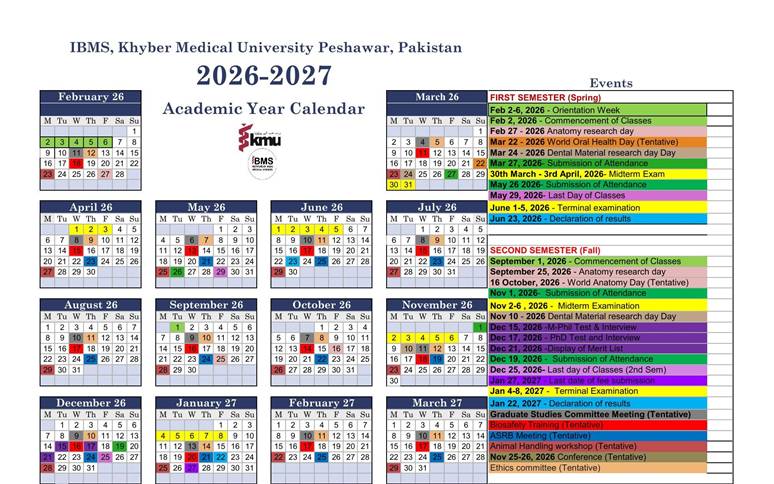
Key dates — First Semester (Spring 2026): Orientation Week Feb 2–6, 2026; Commencement of Classes Feb 2, 2026; Midterm Exam Mar 30 – Apr 3, 2026; Last Day of Classes May 29, 2026; Terminal Examination Jun 1–5, 2026; Declaration of Results Jun 23, 2026.
Key dates — Second Semester (Fall 2026): Commencement of Classes Sep 1, 2026; Midterm Examination Nov 2–6, 2026; Last Day of Classes Dec 25, 2026; Terminal Examination Jan 4–8, 2027; Declaration of Results Jan 22, 2027.
2.5 Learning Outcomes
- Apply core concepts and techniques of human nutrition and related basic sciences effectively in practice.
- Identify, formulate, and address nutrition-related health problems at individual and community levels.
- Translate nutrition knowledge into practical dietary and clinical applications in professional settings.
- Develop and conduct independent research studies in the field of human nutrition.
- Conduct literature reviews and perform statistical analysis using appropriate software tools independently.
- Present and publish research findings at national and international conferences and peer-reviewed journals.
- Manage and coordinate nutrition research projects efficiently and professionally.
- Apply ethical principles and professional judgment in nutrition research and community-based practice.
- Understand the role of nutrition in addressing key public health challenges in Pakistan and globally.
- Demonstrate responsible professional practice with accountability in ethical decision-making in nutrition and health care.


Research
Faculty Publications — Detailed Index
S. No. | Faculty | Title | Journal | Publisher | Year | ISSN | Type | Indexed |
817 | Dr. Bibi Hajira | Impact of high-protein, low-calorie diet on anthropometric indices, glycation, and inflammation associated with the fat mass and obesity (FTO) gene | Frontiers in Nutrition | Frontiers Media SA | 2025 | 2296-861X | Article | Yes (Scopus & WoS – SCIE) |
818 | Dr. Bibi Hajira | Association of anthropometric indices with rs9939609 FTO gene polymorphism among overweight/obese women with breast cancer: a case-control study | Frontiers in Nutrition | Frontiers Media SA | 2025 | 2296-861X | Article | Yes (Scopus & WoS – SCIE) |
819 | Dr. Bibi Hajira | Effect of bread incorporated with flaxseed powder on postprandial glycemia and palatability in healthy individuals | Revista de Nutrição | PUC-Campinas | 2025 | 1415-5273 / 1678-9865 | Article | Yes (Scopus) |
820 | Dr. Bibi Hajira | Association between sleeping quality and risk of breast cancer among women: a case-control study from Pakistan | Cancer Control | SAGE Publications | 2024 | 1073-2748 | Article | Yes (Scopus & WoS – ESCI/SCIE) |
821 | Dr. Bibi Hajira | Food temperature altered macronutrients induced changes in satiety hormones; GLP-1 and CCK and their correlation with subjective satiety | Journal of Family and Community Medicine | Wolters Kluwer (Medknow) | 2024 | 2230-8229 / 2229-340X | Article | Yes (Scopus & WoS-ESCI) |
822 | Dr. Bibi Hajira | Effect of Meal Frequency on Insulin Response and Total Insulin Secretion in Physically Active People | Kurdish Studies | Transnational Press London | 2024 | 2051-4883 / 2051-4891 | Article | No (discontinued from Scopus) |
823 | Dr. Bibi Hajira | Consumption of High Fat and Hot Temperature Meals Induces Higher Subjective Satiety and Reduces Hunger | Journal of Population Therapeutics and Clinical Pharmacology | JPTCP | 2024 | 1710-6222 / 2561-8741 | Article | Yes (Scopus) |
824 | Dr. Bibi Hajira | Determinants of Diarrhea Among Children Aged 1–6 Years in Flood-Affected Areas of Pakistan | American Journal of Tropical Medicine and Hygiene | ASTMH | 2023 | 0002-9637 / 1476-1645 | Article | Yes (Scopus & WoS) |
825 | Dr. Bibi Hajira | Effect of sorghum and barley-containing bread on plasma total polyphenols, antioxidant status and inflammation in healthy subjects | Journal of Food Science and Technology | Springer Nature | 2022 | 0022-1155 / 1573-5104 | Article | Yes (Scopus & WoS – SCIE) |
826 | Dr. Bibi Hajira | Combined effect of sorghum and barley flours incorporation on in-vitro starch digestibility, estimated glycemic index and consumer acceptability of white bread | Sarhad Journal of Agriculture | University of Agriculture, Peshawar | 2022 | 1016-4383 / 2224-526X | Article | Yes (Scopus) |
827 | Dr. Huma Naqeeb | Impact of high-protein, low-calorie diet on anthropometric indices, glycation, and inflammation associated with the fat mass and obesity (FTO) gene among individuals with overweight/obesity | Frontiers in Nutrition | Elsevier | 2025 | 2296-861X | Article | Yes (Scopus & WoS) |
828 | Dr. Huma Naqeeb | Association Between Sleeping Quality and Risk of Breast Cancer Among Women: A Case-Control Study From Pakistan | Cancer Control | SAGE | 2024 | 1526-2359 | Article | Yes (Scopus & WoS) |
829 | Dr. Huma Naqeeb | Scientific basis of dietary inflammatory index (DII): A dietary tool to metabolic syndrome risk | Clinical Nutrition Open Science | Elsevier | 2025 | 2667-2685 | Review | Yes (Scopus & WoS) |
830 | Dr. Huma Naqeeb | Improvement in cardio-metabolic health and immune signatures in old individuals using daily chores (Salat) as an intervention: A randomized crossover study | Frontiers in Public Health | Elsevier | 2022 | 2296-2565 | Article | Yes (Scopus & WoS) |
831 | Dr. Huma Naqeeb | Dietary and Lifestyle Characteristics and Metabolic Disorders in Reproductive-Age Women: Explorative Study in Peshawar Pakistan | Journal of Health and Rehabilitation Research | JHRR | 2024 | 2791-156X | Article | — |
832 | Dr. Huma Naqeeb | Molecular crosstalk between polyphenols and gut microbiota in cancer prevention | Nutrition Research | Elsevier | 2024 | 0271-5313 | Review | Yes (Scopus & WoS) |
833 | Dr. Huma Naqeeb | Association of anthropometric indices with rs9939609 FTO gene polymorphism among overweight/obese women with breast cancer: a case-control study | Frontiers in Nutrition | Elsevier | 2025 | 2296-861X | Article | Yes (Scopus & WoS) |
834 | Dr. Afshan Ghafoor | Dietary diversity in reproductive-aged women by sociodemographic characteristics: a cross-sectional study in Combined Military Hospital, Pakistan | Northwest Journal of Medical Sciences | — | 2024 | — | — | No |
835 | Dr. Afshan Ghafoor | Global Dietary Recommendations Score in reproductive-aged women by sociodemographic characteristics: a cross-sectional study in Combined Military Hospital Peshawar, Pakistan | Northwest Journal of Medical Sciences | — | 2025 | — | — | No |
836 | Dr. Khalid Iqbal | Association of micronutrient status with thyroid function in adolescent Afghan refugees; a cross-sectional study | Thyroid Research | BioMed Central Ltd | 2025 | 1756-6614 | — | Yes |
837 | Dr. Khalid Iqbal | Approaches for harmonization of biomarker data from multiple studies: a narrative methodological review | AJE Advances: Research in Epidemiology | — | 2025 | — | — | No |
838 | Dr. Khalid Iqbal | Global, regional, and national prevalence of child and adolescent overweight and obesity, 1990–2021, with forecasts to 2050 | The Lancet | Elsevier B.V. | 2025 | 0140-6736 / 1474-547X | — | Yes |
839 | Dr. Khalid Iqbal | The state of health in Pakistan and its provinces and territories, 1990–2019: a systematic analysis for the Global Burden of Disease Study 2019 | The Lancet Global Health | Elsevier Ltd | 2023 | 2572-116X / 2214-109X | — | Yes |
840 | Dr. Khalid Iqbal | Adolescent Afghan refugees display a high prevalence of hyperhomocysteinemia and associated micronutrient deficiencies indicating an enhanced risk of cardiovascular disease | Nutrients | MDPI | 2022 | 2072-6643 | — | Yes |
841 | Dr. Khalid Iqbal | Using food network analysis to understand meal patterns in pregnant women with high and low diet quality | International Journal of Behavioral Nutrition and Physical Activity | BioMed Central Ltd | 2021 | 1479-5868 | — | Yes |
842 | Dr. Khalid Iqbal | Food-network Analysis: The impact of change in food intake on other foods and energy intake | International Journal of Epidemiology | Oxford University Press | 2021 | 0300-5771 / 1464-3685 | — | Yes |
843 | Dr. Khalid Iqbal | Nutritional status of adolescent Afghan refugees living in Peshawar, Pakistan | Nutrients | MDPI | 2021 | 2072-6643 | — | Yes |
844 | Dr. Khalid Iqbal | Global, regional, and national progress towards Sustainable Development Goal 3.2 for neonatal and child health | The Lancet | Elsevier B.V. | 2021 | 0140-6736 / 1474-547X | — | Yes |
Publications
- Cardiovascular Diseases in Relation to Anthropometric, Biochemical and Dietary Intake in Women: A Case Control Study — Paracha, PI ; Waheed, H ; Paracha, SI et al , Obesity Research Open Journal (2015) — Dr. HUMA NAQEEB
- NUTRITIONAL ASSESSMENT OF CHILDREN LESS THAN 2 YEARS OF AGE ADMITTED WITH DIARRHEA IN A TERTIARY CARE HOSPITAL OF PESHAWAR, KHYBER PAKHTUNKHWA — W. Shah, H. Naqeeb , Journal of rehman medical institute (2016) — Dr. HUMA NAQEEB
- DIETARY PATTERNS AND RISK OF BREAST CANCER AMONG WOMEN: A CASE-CONTROL STUDY — Huma Naqeeb, Zia-Ud-Din, Sami Siraj, Zafar Iqbal, Imran Khan , Pakistan journal of physiology (2021) — Dr. HUMA NAQEEB
- ASSOCIATION BETWEEN VITAMIN D STATUS AND VITAMIN D RECEPTOR GENETIC POLYMORPHISMS, AND BREAST CANCER RISK: A CASE CONTROL STUDY — H Naqeeb, S Siraj, Z U Din , Journal of Tianjin University Science and Technology (2022) — Dr. HUMA NAQEEB
- Improvement in cardio-metabolic health and immune signatures in old individuals using daily chores (Salat) as an intervention: A randomized crossover study in a little-studied population — Alam I, Ullah R, Jan A, Sehar B, Khalil AAK, Naqeeb H, Ali EA, Wahab QMF, Safdar M, Ali A, Zaman MH and Zeb F , Frontier of public health (2022) — Dr. HUMA NAQEEB
- Molecular crosstalk between polyphenols and gut microbiota in cancer prevention — Falak Zeb, Huma Naqeeb, Tareq Osaili, MoezAllslam Ezzat Faris, Leila Cheikh Ismail, Reyad Shakir Obaid, Farah Naja, Hadia Radwan, Hayder Hasan, Mona Hashim, Sharifa AlBlooshi, Iftikhar Alam , Nutrition research (2024) — Dr. HUMA NAQEEB
- Association Between Sleeping Quality and Risk of Breast Cancer Among Women: A Case-Control Study From Pakistan — Naqeeb H, Zia-Ud-Din, Khan I, Haq IU, Zeb F, Hajira B, Alam I, Iqbal Z, Masood R, Aftab M , Cancer control (2024) — Dr. HUMA NAQEEB
- Dietary and Lifestyle Characteristics and Metabolic Disorders in Reproductive-Age Women: Explorative Study in Peshawar Pakistan — Iqbal, R., Janat Ul Mawa, Huma Naqeeb, Sadaf Ambreen, Sidra Shah, Maria Noor Us Saba, Amna, Zia Ud Din, & Muhammad Zubair , Journal of Health and Rehabilitation Research (2024) — Dr. HUMA NAQEEB
- Scientific basis of dietary inflammatory index (DII): A dietary tool to metabolic syndrome risk — Falak Zeb, Tareq Osaili, Huma Naqeeb, MoezAllslam Ezzat Faris, Leila Cheikh Ismail, Reyad Shakir Obaid, Farah Naja, Hadia Radwan, Hayder Hasan, Mona Hashim, Dimitrios Papandreou, Ioannis Savvaidis, Sharifa AlBlooshi, Iftikhar Alam , Clinical Nutrition Open Science (2025) — Dr. HUMA NAQEEB
- A Review on the Influence of Nutritional Status on Cognition Performance of School Going Children — Khushnuma, Azeem, J., Naqeeb, H., Zeb, Z., Mehboob, N., Bilal, & Bibi, A , Indus journal of bioscience research (2025) — Dr. HUMA NAQEEB
- EFFECTIVENESS OF FOLIC ACID FORTIFICATION AND SUPPLEMENTATION IN NEURAL TUBE DEFECTS: A CALL FOR CONTINUED EFFORTS AND FUTURE RESEARCH. A SYSTEMATIC REVIEW — Jabeen, Aleena & Naqeeb, Huma & Siddiq, Kalsoom & Ambreen, Sadaf & Bibi, Ayesha & Dilawar, Muhammad & Khan, Ismail , Frontier in medical and health research (2025) — Dr. HUMA NAQEEB
- Association of anthropometric indices with rs9939609 FTO gene polymorphism among overweight/obese women with breast cancer: a case-control study — Naqeeb H, Sehar B, Siraj S, Almajwal AM, Hajira B, Faris M, AlBlooshi S, Alsubaie ASR, Safdar M, Alam I, Zeb F , Frontier Nutrition (2025) — Dr. HUMA NAQEEB
4. Department Details
4.1 Laboratories
Human Nutrition Lab
S. No. | Facilities / Equipment |
1 | Physician scale |
2 | Height board |
3 | Height pediatric board |
4 | Weight scales |
5 | Early Childhood Development (ECD) kits |
6 | Hand grip |
7 | Refrigerator |
8 | Body composition analyzer |
Clinical Trial Room
S. No. | Facilities / Equipment |
1 | Household fridge |
2 | Kitchen scale |
3 | Solar burner |
4 | Oven |
The department also has access to the Human Nutrition and Biochemistry Joint Laboratory, IBMS (equipment listed in Section 4.3 — Equipment).
4.2 Research Facilities
Expectation Outcome Indicators (EOIs): Laboratory manuals, documentation and instructions for experiments must be available and readily accessible to faculty and students.
4.3 Equipments
Human Nutrition and Biochemistry Joint Laboratory, IBMS
Instrument Name | Company | Model | Made By | Status |
Trans Blot | Bio-Rad | SD Cell | USA | Not Installed |
ELISA | Biotac | ELX 800 | USA | Functional |
PCR Machine / Thermal Cycler | Bio-Rad | T100 | Singapore | Functional |
XS Sysmex (Hematology Analyzer) | S Ijaz-ud-Din | XS-5001 | Japan | Functional |
Refrigerated Centrifuge | N-Biotek | NB-15000CFN11 | — | Functional |
Water Bath Shaking | Wise Bath | WSB-30 | Korea | Functional |
Heating Magnetic Stirrer | Velp Scientifica | — | Italy | Functional |
Vortex | WISD 23 | W SEMIX | Korea | Functional |
Digital Balance | Shimadzu | AUW 320 | Japan | Functional |
Microwave Oven | Dawlance | — | — | Functional |
Digital Balance | Shimadzu | — | Japan | Functional |
Vertical Electrophoresis | Waltec | Elite 300 Plus | USA | Functional |
Horizontal Electrophoresis | Waltec | Elite 300 Plus | USA | Functional |
pH Meter 3110 | Rays WTW | WTW | Germany | Functional |
Nano Drop | Tittered Berthold | — | Germany | Functional |
-80°C Deep Freezer | Panasonic | MDF/U55B/PE | Japan | Functional |
Computer System for RT-PCR | Compaq | — | — | Functional |
Autoclave | Samheung Energy | AC 60 M | Korea | Functional |
Pipette Set (3 pipettes: 10 µl, 100 µl, 1000 µl) | — | Lambda Plus | — | Functional |
ETT Machine | — | — | — | Functional |
Refrigerator | Orient | — | — | Functional |
Cobas C111 | Roche | — | — | Functional |
CO2 Incubator | Human Lab | SO8P2196-02 | — | Functional |
Flow Cytometry | — | — | — | Not Installed |
Gel Electrophoresis Tank | — | — | — | Not Installed |
Mini Gel Electrophoresis Tank | — | — | — | Not Installed |
-40°C Freezer | — | — | — | — |
HPLC | — | — | — | — |
Digital Spirometer | — | — | — | Functional |
Contact
For inquiries related to the Department of Human Nutrition, please use the main Contact page.